When learners begin reading Japanese stories,
they often meet numbers first.
The next step is words.
This book introduces words in a very Japanese way—
through a simple word game called shiritori.
 Image source: ASK Publishing official website
What is shiritori?
Shiritori (しりとり) is a traditional Japanese word game.
It is very simple:
-
One person says a word
-
The next word must start with the last sound of the previous word
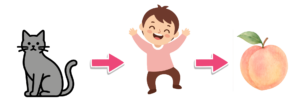
For example:
-
ねこ (neko) → こ
-
こども (kodomo) → も
-
もも (momo) → も
That is all.
Because the rules are simple,
shiritori is often one of the first language games Japanese children play.
And that is exactly why it works so well for learners.
A story built around a game
This book is part of the
レベル別日本語多読ライブラリー にほんご よむよむ文庫
and belongs to the very first (Starter) level, together with
「一つ二つ三つ」.
Just like the previous book, it is designed for:
-
learners reading Japanese stories for the first time
-
learners who want Japanese to feel safe and familiar
You do not need:
-
grammar explanations
-
long vocabulary lists
-
confidence
You only need curiosity.
Learning words without memorizing them
This book introduces words through shiritori.
That means you naturally see:
-
simple nouns
-
everyday objects
-
familiar sounds repeated again and again
You are not told,
“Please memorize these words.”
Instead, you:
-
see how words connect
-
notice sounds at the end and beginning
-
feel how Japanese words flow into each other
You learn by recognition, not by effort.
Why shiritori works so well for beginners
Shiritori is powerful because it:
-
focuses on sound, not translation
-
encourages attention without pressure
-
makes repetition feel natural
When you play shiritori, you are not thinking:
“What does this word mean in English?”
You are thinking:
“What sound comes next?”
That shift is important.
It gently moves you away from translation
and closer to Japanese itself.
From reading to playing
One of the best things about this book is what comes next.
After reading it, you can try shiritori yourself.
You can:
-
play alone
-
play with a friend
-
play with a teacher
-
or even play with AI tools like ChatGPT
You do not need perfect Japanese.
Even a small number of words is enough to begin.
This turns Japanese from something you study
into something you use.
A calm step forward
If 「一つ二つ三つ」 helped you feel:
“I can read Japanese,”
then this book helps you feel:
“I can play with Japanese.”
It is still gentle.
It is still short.
It is still safe.
But it quietly expands your world of words.
Who this book is for
This book is especially good for:
-
beginners who finished their first Japanese story
-
learners who want to increase vocabulary naturally
-
people who enjoy playful, low-pressure learning
-
learners curious about Japanese culture
If Japanese words feel heavy or difficult,
this book makes them light.
Where to find the book
If you would like to purchase this book,
you can find official information here:
(This book is part of a graded reader series and may be sold as part of a set.)
Final note
This is not a vocabulary book.
It is not a test.
It is an invitation.
An invitation to notice sounds,
connect words,
and enjoy Japanese as it is used.
In the next articles, I will continue introducing books from this series,
slowly and carefully—
always keeping Japanese comfortable and approachable.