After very gentle starter stories,
this book offers a small but important step forward.
「田舎のネズミと町のネズミ」 is a familiar story told
in calm, simple Japanese—
with just a little more language to explore.
It is a story many learners already know,
and that familiarity makes it a perfect bridge
between Starter and Beginner levels.
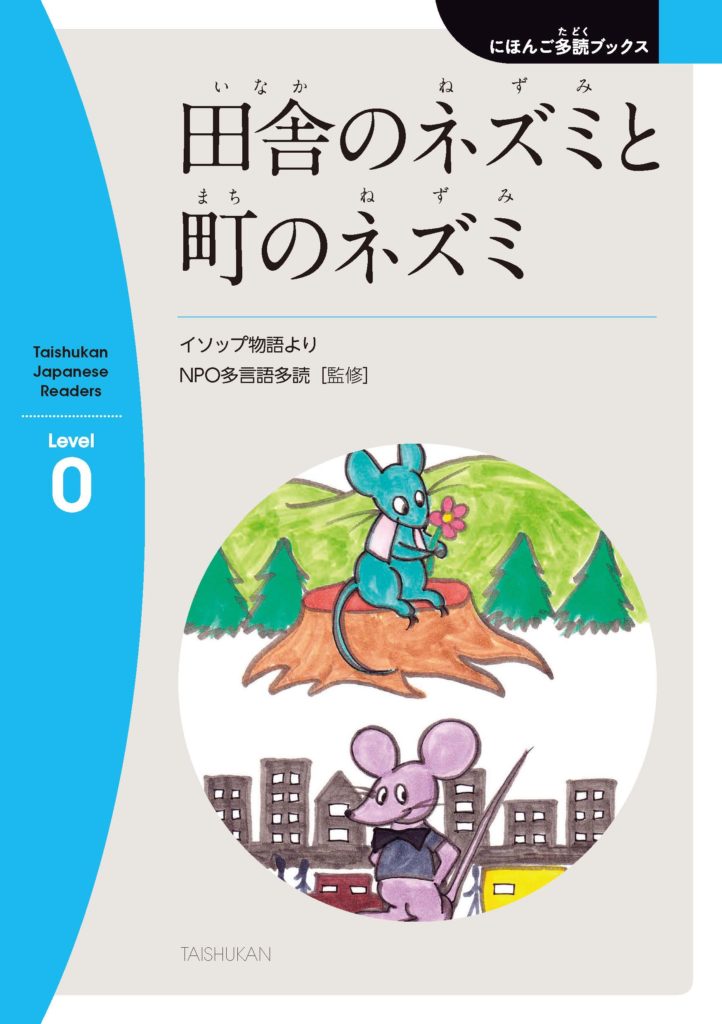 Image source: Nihongo Tadoku website
A familiar story, told simply
This book is part of the Nihongo Tadoku Books series (Vol. 1).
It is written at Level 0,
which sits gently between Starter and Beginner.
The story comes from Aesop’s Fables.
Two mice live very different lives:
-
one in the countryside
-
one in the town
Through their experiences,
the story quietly asks a simple question:
What does it really mean to live well?
You do not need to know the ending in advance.
If you already know the story, that helps.
If you don’t, that’s fine too.
Why familiar stories work so well
One of the biggest challenges in early reading
is not vocabulary or grammar.
It is uncertainty.
This book removes that uncertainty by using a story
many people already recognize.
Because you roughly know what is happening,
you can focus on:
-
how Japanese expresses ideas
-
how sentences connect
-
how descriptions are built
You are not struggling to understand the plot.
You are noticing the language.
A gentle step beyond Starter level
Compared to Starter-level books, this story offers:
-
slightly longer sentences
-
more descriptive language
-
clearer cause-and-effect relationships
But the pace is still calm.
You are never rushed.
You are never tested.
This makes it ideal for learners who think:
“Starter feels comfortable,
but I want a little more.”
This book is that “little more.”
Learning through contrast
This story is built around contrast:
-
countryside vs. town
-
quiet vs. busy
-
safety vs. excitement
These contrasts are expressed through simple Japanese,
often repeated in different forms.
That repetition helps you feel how Japanese compares ideas
without formal explanation.
You begin to sense meaning,
not translate it.
Reading without pressure
This is not a book to analyze.
It is a book to read calmly.
You may notice:
-
familiar verbs used in new contexts
-
descriptive words appearing again and again
-
sentence patterns that feel increasingly natural
Understanding does not arrive all at once.
It accumulates quietly.
Who this book is for
This book is especially good for:
-
learners finishing Starter-level readers
-
people who want a bridge to Beginner texts
-
learners who like familiar stories
-
readers who want meaning without difficulty
If you feel ready to move forward—but not rush—
this book fits perfectly.
How to read this book
I recommend reading it like this:
-
Read for the story first
-
Do not stop for every unknown word
-
Let familiar scenes guide your understanding
-
Notice repetition and contrast
You can reread it later
and discover more each time.
That is how graded readers work best.
Where to find the book
If you would like to purchase this book,
you can find official information here:
(This book is part of a graded reader series and may be sold as part of a set.)
Final note
This book does not ask you to choose
between countryside and town.
It asks you to slow down
and notice how Japanese tells a story.
That noticing—
that quiet attention—
is where real learning begins.